Thursday, September 24, 2020

Ascending and Descending the Grades aka dig the new breed

I remember the days of ascending the ladder of grades while learning how to climb/survive at the Gunks. It was always a bit ambiguous because grades are such an approximation of difficulty, and more so the further into the past you go. Thirty or more years ago the hardest climbs were actually within spitting distance of those we could get on, which is no longer the case. As life took over, and climbing became more of a luxury and less of a necessity, we peaked, somewhere in our 20s or 30s. I know others don't, and have 2 friends who started in their 40s and went on to impressive careers on climbs harder and more magnificent than my best efforts. I have a long-time climbing partner who can rise back up the grades every time he gets the bug again. 

After a while I found myself top roping more ambitious climbs I would once have saved for an onsight lead. I started to descend in the grades, touching bottom while following the airy Thin Slabs Direct, recognizing I would have to hit the gym to even keep in the game. I saw my weight creep up, even as I worked harder to stay fit than I had in my youth, and it is true the harder/heavier they come, the harder they fall. I try not to fall. At all. It is the opposite of the observation by my good friend Henry Blodget in our teens, that until we started falling, we were not going to figure out where our limits were, and improve upon that high water mark. He was right, and I did explore those horizons, and was lucky to suffer no serious injury. 

Then something turned. My son Tobias, now 13, got interested in climbing, or at least the idea of going climbing and the camaraderie. He's no featherweight , so we have parity on that front. He's not game all the time, and requires much food to fuel his enthusiasm, but it's a great treat to get out there and focus on something other than the undeniably narcissistic cult of self climbing has embedded in its culture.


Tobias topropes Son of Easy O 5.8 Trapps Gunks


I've also been lucky to have friends who are great at mentoring Toby. As any parent knows, there is no easy way to teach your passions to your children: they are often much more resistant to pushing themselves in front of their parents than they are in front of others. It is incredible to work with other adults who can get over the friction of the family romance and get down to the business of staying alive while pursuing some of life's greatest joys. 

When Toby was about 4, we went to Chamonix to visit his godmother. He had only skied on toy skis, and wept pitifully when we had him equipped with rental alpine gear. He looked poised to breakdown again as we left the van with my guide who just saw me down the Valle Blanche the day before. As we were walking across the parking lot the guide, Sylvain Ravanel, http://www.guidos.fr, said with Gallic non-challance, 'un moment.' He returned to the mini with Toby, they conferred for 30 seconds, they emerged, Toby hiked his skis on shoulder and strode across the parking lot as if a man on a mission. 

When later we asked Sylvain what had transpired he said deadpan 'that is between me and Toby'. He also admitted that although a Olympic candidate on xc skis, he had been unable to teach his own 3, 6 and 9 year old boys to ski largely leaving it to others too. Toby proceeded to ski all morning until he ate a lunch the size of his torso and then skied another 3.5 hours in the afternoon, finishing on Sylvain's shoulders for the last run, and a full carry across the parking lot.


Sylvain and Toby at La Thuile, Italy, near Cormayeur/Mt. Blanc


Toby showed similar, somewhat uncharacteristic grit when xc-skiing at my parent's place in upstate New York. He would shuffle around on said toy skis, and once after covering 2-3 miles I asked if he wanted real ones. The answer was a foregone conclusion. So now there's backcountry skiing.


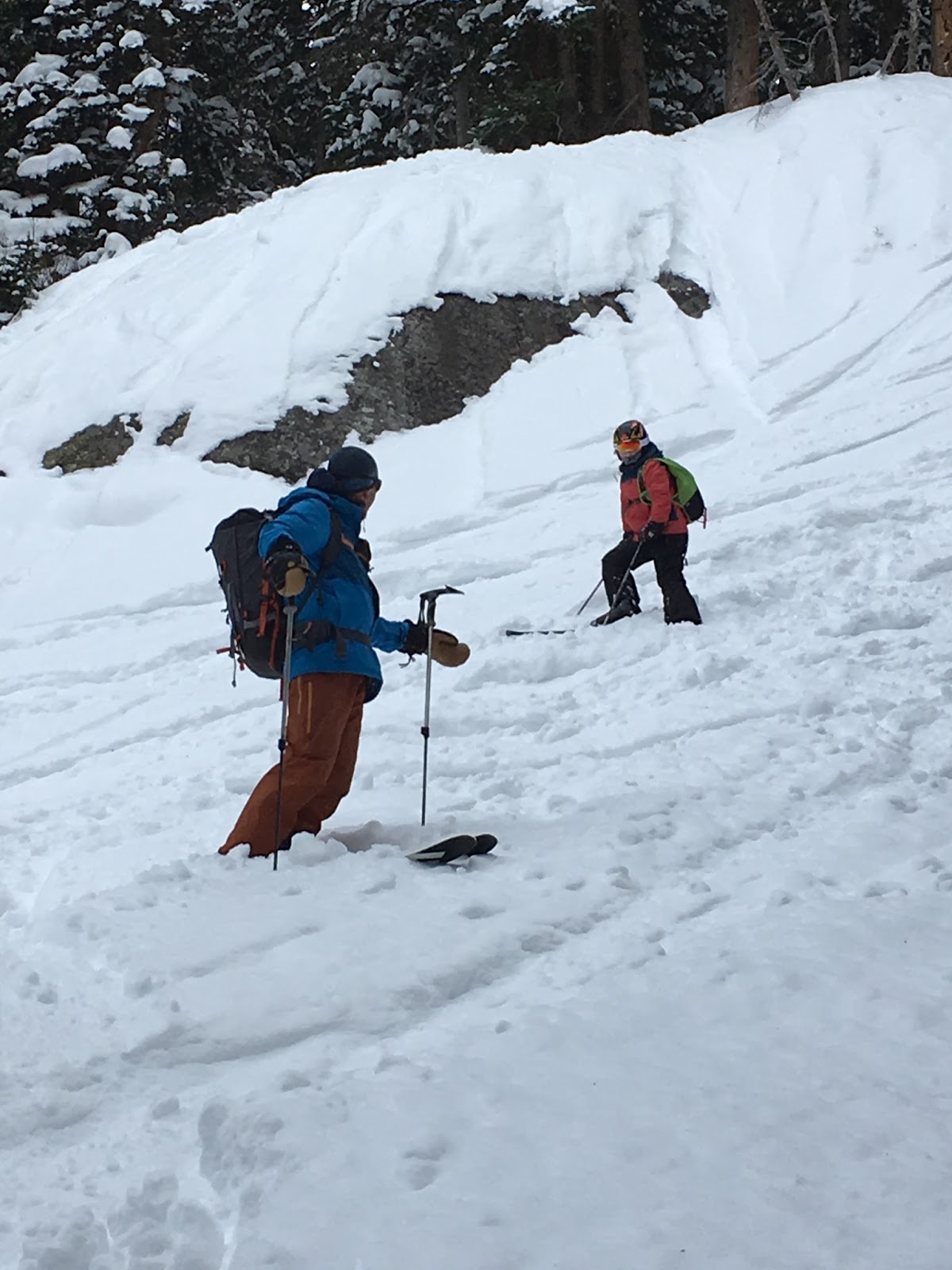
Truly this is Toby's passion, and if it will convince another 13-year old that it's worth sweating in the skin track for house and sleeping in subzero temperatures, it's alright by me.

Sunday, September 15, 2019

Just a box of Gear


This is a tale of boxes of hardware. They really are just objects. But they come with stories. In high school I discovered the art teacher John Wharton had done an early ascent on El Cap. When I bearded the somewhat grumpy New Englander he told me nothing of the ascent, and I can't find it so would love to know what/if it was. He offered or really gestured me towards a box of old pitons. It was not a big box. He indicated he's used that as much of his rack on the route, or that's what I gathered. It consisted of a couple of dozen pins and angles, most obviously pretty homemade. I used a few of the small chouinard angles and lost arrows over the years while mixed climbing, but most of it remains in that same small box, in my mother's basement, near the xc skis and tire chains. 

More recently I opened a box which had been sitting unidentified in one of my company's warehouses for a few years. I had seen the name on it before, Rolando Garibotti, but it was a German shipment to an address in Germany which had long since gone astray and I assumed it couldn't be the same person I was thinking of. This summer I opened it. It was a bunch of top-of-the line cams, some slings, daisy chains and a pair of pants, all from 2016, but as good as new with original tags and packaging. They were in fact for Rolo. I contacted his sponsor who could not help given the age of the order. I left a message at Pataclimb.com, Rolando's website, and heard back. He expressed cheerful surprise in the fact that someone out there was honest enough to try and repatriate him and his gear, which he thought long gone. 

As I age up the years and down the climbing grades, and spend time on more sensible pursuits with my child (flying drones, trail work, skiing), I am warmed by these touchpoints with elders of a tribe I am sometimes further from than I wish. 

Tuesday, October 3, 2017

six pieces of silver

So I have three items which I (more) obsessively upgrade and mull over than most pieces of kit. They are a shell, a ski and a pack. I've done the pack thing. Wait, you say that's not six pieces? You're right. I just like the album. If you have not heard it, get it.

Shells Shells have long been just about the most overrated, overpriced, chunks of junk for most of their history. I remember when a cagoule was high tech. But there are times you want one, and good ones are better than bad. There are hard shells, soft shells and hybrids. I am often annoyed with myself for having so many, but there are a few good reasons to have a few good ones.

  • Rain I think it was Marc Twight who said 'if it's raining go home'. While this is prudent advice for alpine climbing, I have not always followed it (the freezing line must be just ahead...), and when you don't, you need a shell. If I don't think I'm using it much, I'll bring a very lightweight one and hope to keep it in my pack. The Arc'teryx Alpha SL or FL is very good. There are nice less expensive versions from Mountain Hardware, Marmot, many others, and the Alpha only has one pocket, which is limiting if you wish to use it more casually. I have a really great Solomon Bonatti WP stretch shell which is like an upgraded Patagonia Houdini, much more weather protection, stretch, and every bit as indispensable clipped to a harness.

  • Driving Snow I personally think that 'full conditions' are only for those of Scottish descent and residents of the Northeast. Wait..I'm both. I like a heavier 3 layer Gore-tex shell for these kinds of conditions, or any serious wind. If there is serious wind but no precip, I'll opt for a softshell. I like the older Arc'teryx windstopper I have very much, as long as it's not too warm. If it is, I'll go with an even older one without the windstopper. The Arc'teryx SV is pretty much the bomb in these conditions. Mine is 15 years old and rarely broken out, but they are the standard. I have a Rab with stretch but the main zipper is a real bear to operate. Otherwise a great jacket, especially the oversized hood with wire brim. The pants, also Gore-tex Pro, are also very well dialed, if a bit more fussy in design than the Canadians.
  • Cold Wind Snow If I'm ice climbing, the Arc'teryx Windstopper stretch softshell top and old polartech softshell salopettes with built in knee pads are best. They are almost worn out and I think I'll have to turn to Northwest Alpine who have said they'd modify theirs to match that. It's an incredibly warm, mobile, comfortable combination for a 'go suit' for most climbing conditions. It's a little too warm for me for most ski mountaineering, when I prefer a non windstopper, Arc'Teryx Gamma top and a thinner pant. For skiing the Rab stretch Gore-tex Pro pants or the Alpha SV bibs seem to be best, depending on temperature.

  • Warmer Windy When rock climbing I generally won't wear more than a long john top. If I may however get chilly up top belaying. If so, I'll bring a small puffy, I have a remaindered old Patagonia which works well, or if it's not that cold I'll use their Houdini. This is a very lighweight item, but it's lasted me for years and is welcome each time I use it. I recently got the lightest Arct'eryx hooded puff, no insulation in the hood, and it's fine. In colder than 50-60 F temps, it might help if you remember a hat, but with a helmet it's enough for the shoulder seasons. I think Patagonia's version of this looks a little better (but was not on sale yet.)

Skis I ski very little, just a half dozen to a dozen days a season. But I like it a lot. And I love skis. I have also enjoyed migrating over the years from alpine to tele to AT. I predictably dream about a life where I ski more as I grow older and the work/play balance swings back to play. But I still get plenty of play.

The best skis are ones I have had long and still ski so well. Stelvio Trab's, Atomic Beta cap tele boards, some old BD ascents with silvrettas for approach in mountain boots, even the old atomic sierras we punt around my parents' property on are great. They are only chipped, rusty and worn on the kick pattern. They still ski fine, just like all the best skis. As Andrew says any ski can ski great powder.

In recent years I really like the Dynafit Denali. It's I think a good ski for a moderate skier. I ski a 184 in that and shorter in most others. Longer is too hard to do a kick turn for me, and I don't need more float. It is very light, fun in moderately angled powder and respectable on hard pack. It can also be had for cheap. I like TLT Superlights with no brakes ATK leashes.

©Andrew McLean

The next in line is the Movement Vertex, a ski so good they keep making it. It's a bit like a supercharged Stelvio with marginally less weight. I pair it with Plum Guides, but may like the old Speedturns on the Trabs better. I find the Plum adjustable heel plate shifts, and while I like the beefy beautifully machined heel post on the Plums, the old Speedturn is just so reliable and solid. I do like the Plum brakes which are light and right for some applications. I've been known to lose skis since a very young age...

I have some Atomic Ultimate 78s for ski mountaineering which I've only used on icy hills in the Berkshires. They are short, around 160, but they ski well. Lays down an edge, little bit of rocker, and paired with the old yellow Dynafit TLT5 boot they are a great setup for just about everything except deep.

Finally the ski I'm yet to ski. It's out there somewhere...


Packs come later. I'm still working on that. 

Sunday, March 5, 2017

You call that a liner?

When I first bought a pair of Galibier SuperGuides I was warned to get neoprene sheets and cut them to fit the footprint. The insole of the superGs were beautifully crafted, hard leather. Along with the steel shank you could not have a more perfect conductor of cold from crampons strapped on to them (which is what they were for.) I dutifully used them, and they did cut down on the cold, but I also appreciated the additional cushioning. Fast forward about 35 years and I still like a nice insole, especially with my very flat and flattening feet. I use the term 'insole', 'footbed', and 'liner' interchangeably throughout this rant. 

(Benjamin Dulchin sporting said Galibier Super Guides in their 3rd decade, somewhere on the Sisters in the Adirondacks I think)

I'm a long time user of Superfeet's green, and at least one pair of orange insoles. I like their new black ones just as much as all I've used. The holes in the forefoot seem like they might breathe better, but I not sure and have used them only in cool and cold weather. The holes do cut some minor amount of weight. Maybe they are supposed to look cool and I’m overthinking it. They do last less long than professional leather orthodics, more on the pros below.

Custom orthotics insoles (what I used to call boot liners) are a luxury and arguably fit your individual feet best. Superfeet does offer a range of off-the-rack insoles for high arch/volume, etc. Except for the most specialized custom orthopedic applications, like for very small last ski boots (think Dynafit TLT 5s, more on that later) or other weird shapes, I'd use these. You can always trim them. I like to buy them to fit, which they do, and well. A good fit is also as warm as that specific boot will ever get. If you have a good fit on your boot you can focus on climbing or skiing as well as you can, whatever that means. Uncomfortable feet generally drive normal folks from the sport by which they experience that discomfort.

Cousin Joseph Hooper after almost stepping out of generously sized boots in the Catskills (Spiral Staircase?)

The insoles/liners these sometimes replace are those stock ones included by boot manufacturers who would like to sell you their $600 mountaineering or $900 AT boots. They should put these in there as stock, or something of similar quality. La Sportiva is the only one who includes footbeds which I'll repurpose/cut down for my child. The others are a placeholder, an admission by the manufacturer that it's not included in the price of their premium boot. It's similar to upgrading to an Intuition or Paulau moldable ski boot full liners (which top manufacturers do include): those who offer a premium boot should include a premium footbed/insole/liner. I think these are enough of a mountain standard that manufacturers of high-end boots should make them standard. And I like them in approach and work shoes too. If not Superfeet, then something comparable.

So when is it worth plunking down an additional $300-600 for custom orthodic footbeds from a professional? When nothing else works. I used Steve Rueda for some great TLT5s which were way too narrow for anything (http://www.turnpikecomfortfootwear.com), and he was at the low end of the range. The ones he made were based on bamboo and as a skier he totally nailed it. They are so good I use them in my TLT6s, really nothing like it. But when I presented my old Batura 1.0s, he asked if they were comfortable with stock aftermarket insoles, and declined to make customs because I said yes. I have also had street shoe orthos and while nice, the cost is rarely worth it. Except when it is.

So the blog title is from a (?) joke. A man in a trench coat walks up to an aged female fellow passenger on the subway platform. He opens the coat and exposes himself to her. She looks at his open coat, then looks up at him and says 'You call that a lining?'

Sunday, January 22, 2017

Mo Wasatch

Just another pair of busy days in a small fluffy range in middle america...first three and last 6 images are copyright Andrew McLean, the rest are mine.

It was not just good skiing, but exceptional. About half a foot of new on top of a compressible consistent base which did not slide much. We did not ski very steep because of recent snowfall.


Monday, January 16, 2017

Way Back in the Wasatch

By far the best January in the Wasatch I've seen in a decade. The gear was fine. As Andrew says anything skis powder well. We both went big (99 mm and 105ish in the waist) and that was the way to go. It was actually about 5 to 10 inches of fresh on a soft, compressible base. Every day for over a week. Just about as good as it gets. And we took my 9 year old out for his first real backcountry skin and ski. His kit worked well too. Nice for $25 rear-entry Nordica boots and a nice setup of kid's Hagan and skins under small sized Fritchis and god did I mention the snow was great. I skied TLT lights on Denalis with T7s and Andrew is on new Scarpa Maestral's with Dynafit Verts (?) on BD Helio and seems very happy with their blizzard made fine finish skis. 

 Entering Brighton BC via Crest Lift 
Copyright Andrew McLean
 Andrew tells Toby about butter in hot coco on expeditions
Copyright Andrew McLean
  Hitting the skin track into Andrew's zone
Copyright Andrew McLean

 look at that 


  And he stripped Toby's skins and put them on. No, 9 year olds can't apply and remove their own ski skins. Yet.


Fins

Thursday, January 21, 2016

Back in Salt Lake City

It would be a lie to state that I attend the Outdoor Retailer show every winter for work alone. And nobody would believe me anyway. However, this year was good on many fronts, both in terms of seeing old friends in the industry and making a few new ones, and some really nice skiing. I participated for the 2nd time ever in 'demo day' at Solitude, where you can ski some great boards and the entire mountain for $40. On a run to the top I took SolBright - right between that ski area and Brighton, and was very pleasantly surprised. The skiing was great on piste, but as I was taking one of many 'acclimatizing breaks' two locals stopped to ask where I was from. When I admitted Brooklyn, and they confessed to be locals, I thought the conversation might grind to a halt. Not so - they quietly told me a route through some low angle trees where I found fresh powder aplenty. I'm not sure how many folks would usually be so generous, but it set a great tone for the trip.

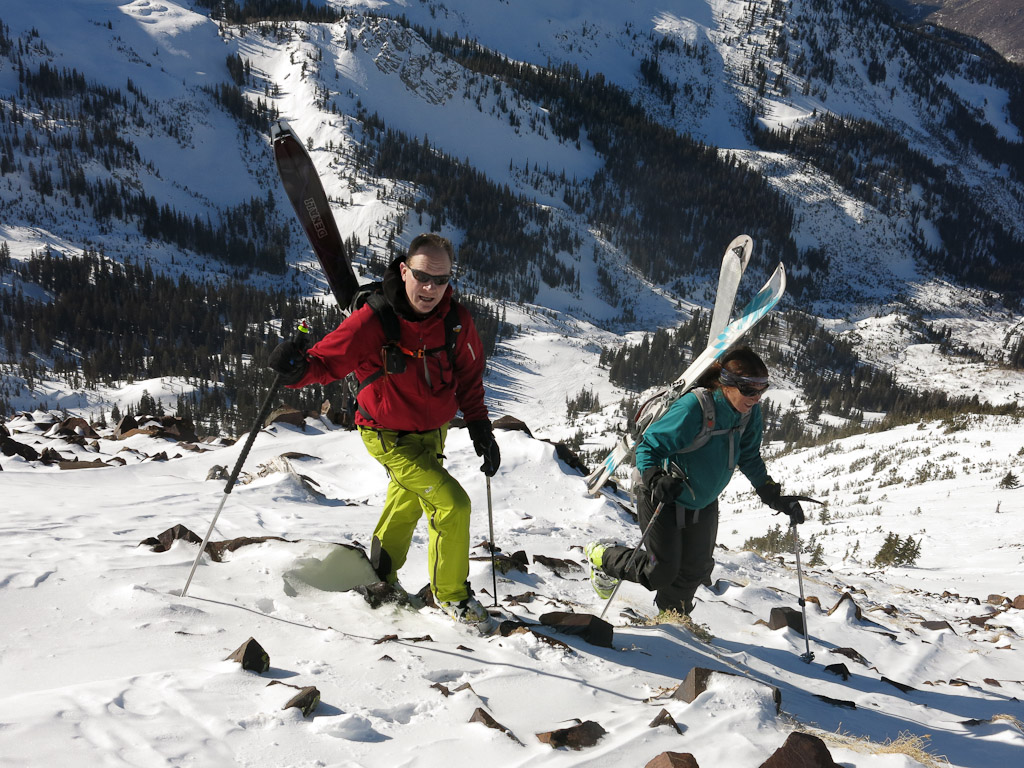
I did actually go to work the show, but the weekend was my time to catch up with legendary guru Andrew McLean, who had enticed me with a stellar view of the Pfeifferhorn from Red Pine the previous year. He thought I was up for it, so we made a plan. Two very fit friends joined, and we were off. A 7am trailhead start was slowed a bit by malfunctioning water bladders (avoid them) and then we were off.


At Red Pine Lake we took a break and got a good view of the ridge. The peak is not the Pfeiff, but is on the way there. The skiing between the clumps of trees was just as fantastic as it looks, as was our second run to the left of the left-most trees.


Copyright Andrew McLean

This is our brief but stressful boot up to the ridge which leads to the Pfeiff. We had fantastic weather until we achieved the ridge, when things got pretty socked in. 


Once we got to the base of the col which then leads to the last 500 or so feet of climbing, we considered our options. 2 of us had no climbing experience, and only 2 of us had headlamps. An attempt was not going to get us much of a view, and would have returned us home after dark. We decided to try another day, but were favored with a very brief view of a peak I'll be back to enjoy again some day.


The ride back down the plateau was non-eventful, but the reversing of the very loose power/rock section below the ridge was far from trivial. No accidents on the job, but it felt a lot like ski mountaineering.


After that the fun began, and we skied the terrain pictured above Red Pine lake. It was the best powder I've had in about 5+ years and well worth the effort.


Size of smiles = quality of company and skiing. I'll be back next year for sure. Thanks as always to Andrew, who continues to demonstrate a high tolerance for my pokey ways.